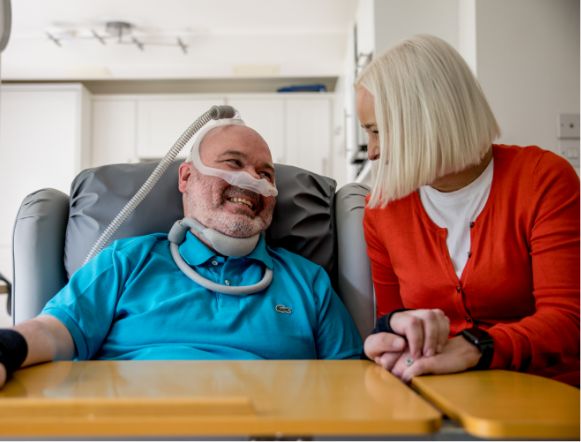
Change can’t wait
People affected by MND deserve support from systems which work quickly and meet their needs. Too often, they do not get this. Our policy and campaigns work focuses on tackling the key issues that impact on people affected by MND, like housing, adaptations and social care.
We work with local and national government, service providers and likeminded organisations to tackle these challenges. Read below to find out more about the influence our policy work has made with the support of people affected by MND and the experiences they have shared.
We’re taking action
When the system fails, MND Scotland is here to guide people through a labyrinth of confusing processes. Every year we see the same problems time and again, including social care, adaptations and accessible housing.
Across the country, there are wait lists exceeding 15 months for a ramp, and 4 years for an alternative accessible property. These waits are difficult for anyone, but when someone has MND, they are devastating and detrimental.
Our report ‘No Time to Lose’ (2022) evidenced the realities facing people with MND across local authorities when it comes to housing and adaptations. As well as highlighting the impact of delays, complex processes, and extensive wait lists, the report also makes evidence-based recommendations like fast-tracking, streamlining processes, and increasing accessible housing builds.
With the experiences that people living with MND and their families have shared, this work on housing has led to tangible changes including:
- The inclusion of proactive assessments for people with rapidly progressing illnesses within the Scottish Government’s Guidance on the Provision of equipment and adaptations (2023) “For people living with progressive terminal conditions, future needs should be planned for, by working closely with the individual, and specialist nurses and occupational therapists, to ensure that equipment and adaptations are provided in time”
- Work with housing associations to secure fast-tracked housing and adaptations processes for people with MND, such as FLAIR’s MND pledge.
- Co-authored guidance for occupational therapists, with the Royal College of Occupational Therapy
- We continue to work with the Scottish Government, MSPs, membership in the Scottish Government’s Adaptations Working Group, Cross Party Groups, and with local authorities and organisational bodies to ensure that the needs of people affected by MND continue to be campaigned for at all levels.
Securing fast-tracked care assessments through Care Reform (Scotland) Act 2025
Through our work with MSPs, we successfully secured the inclusion of fast-tracked social care assessment/reassessment for people with conditions like MND. This means that once secondary legislation is put in place, people with MND across Scotland should receive fast-tracked, prioritised social care assessments, and will have greater flexibility to enable care packages to move with them should someone locate to a different local authority.
Amendment 69, brought forward by Scottish Labour MSP, Paul Sweeney, ensures everyone living with a terminal illness is entitled to a priority care assessment, and expeditious reassessment if their needs change.
We also recommended an amendment to make care packages ‘portable’, meaning an individual’s care and support followed them if they relocated to another local authority area due to their need for an accessible home. This amendment was also passed in the Care Reform (Scotland) Bill.
Now the legislation has passed, regulation is required to determine best practice – including the length of time people will have to wait before being assessed. We are working closely with the Scottish Government to implement this now. The SNP included the urgent implementation of this work within their party manifesto for the 2026 election, as result of our influencing work.
You can read more about our current policy priorities for the Scottish Government in our manifesto.
We successfully campaigned with Marie Curie to improve how terminally ill patients, including those with Motor Neurone Disease (MND), are treated under the Social Security (Scotland) Act 2018.
As a result of our campaign, people living with a terminal illness in Scotland no longer have to prove how long they have left to live to access financial support, for benefits. Prior to our campaign, under the UK system people with MND had to prove that they had just 6 months left to live to be fast-tracked and to claim the maximum level of benefit. This meant people were missing out as it was very difficult to ‘prove’ someone with MND only had 6 months left to live.
Our award-winning campaign fought to ensure people with MND get fast-tracked access to benefits based on clinical judgement of a diagnosis of a terminal illness, without having to prove a specific six-month life expectancy as had been the case previously. The implementation of BASRiS (previously SR1/DS1500) forms which fast-track benefits and financial support are now available to someone with MND from the point they are diagnosed.
Our campaigning is informed by lived experiences of people living with MND and those caring for someone with MND. We are keen to hear from you if you have insights to share with us about your experiences. Alternatively, you can choose to donate today to support our campaigning work and help secure lasting change.
If you are someone living with, or supporting someone with, MND and are facing issues like housing, social care and with benefits and would like support, please contact support@mndscotland.org.uk
Getting involved: If you would like to get involved in our policy work, or share your experiences, please contact policy@mndscotland.org.uk
*Data from our 2022 report ‘No Time to Lose: Addressing the Housing Needs of People with MND’. Average waiting times for accessible housing and home adaptations were gathered. These can be found within the full report.
There's no time to lose
MND is brutally fast. Average life expectancy is just 18 months from diagnosis. People with MND can quickly lose their ability to walk, talk, eat and breathe unaided. They need support to help them live their lives safely and have the best quality of life possible in the precious time they have left.
To keep pace with MND, services need to be put in place quickly yet many people with the illness wait far too long. Tragically, some people never receive the support they need in time.
*Data from our 2022 report ‘No Time to Lose: Addressing the Housing Needs of People with MND’. Average waiting times for accessible housing and home adaptations were gathered. These can be found within the full report.
When her husband was diagnosed with MND, Marie and her son had no choice but to wash Ian on the back decking using a bucket of water, due to delays with essential home adaptations:
“My husband Ian only lived for nine and a half months from diagnosis. That was precious time that we were supposed to spend making memories together. Instead, we spent most of it frustrated and stressed out, battling to get adaptations made to our home.”
Securing
lasting change
Over the last few years, we’ve achieved remarkable progress in Scotland and across the UK on behalf of people with MND. We couldn’t do this without your support.

2025
People living with a motor neuron disease (MND) diagnosis in Scotland are a step closer to receiving priority care assessments following the Care Reform (Scotland) Bill passing on Tuesday, 10 June 2025.
Read more
2022
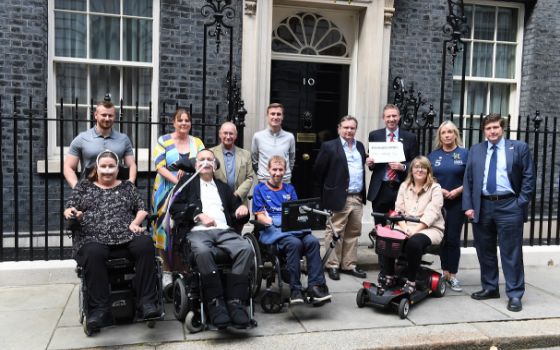
Uniting with MND charities across the UK to secure a £50m commitment from the UK Government to fund a brand-new virtual MND research institute.
Read more
2020
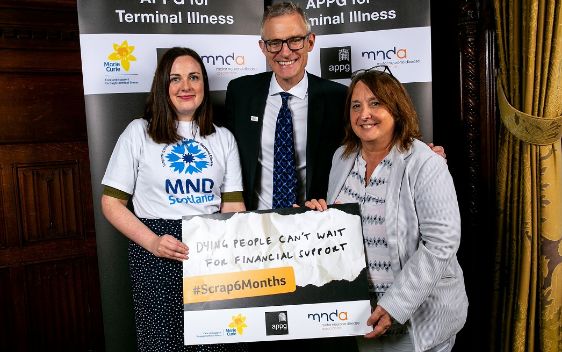
As part of a UK partnership, improving access to UK social security benefits for people with MND.
2018
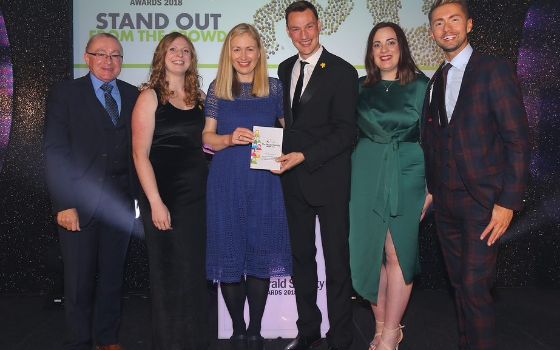
Securing an effective fast-tracking process for new Scottish social security benefits for people with MND.
2015
Winning the right to communication aids supplied by the NHS.

2014
Ensuring people with MND would not need to pay for social care.
Sign up
for newsletter
Get the latest news and events straight to your inbox.
You can help create a world without MND