What is MND
Find support
I have MND
I am supporting someone
Get involved
All events
© MND Scotland 2026
Research
About MND Scotland
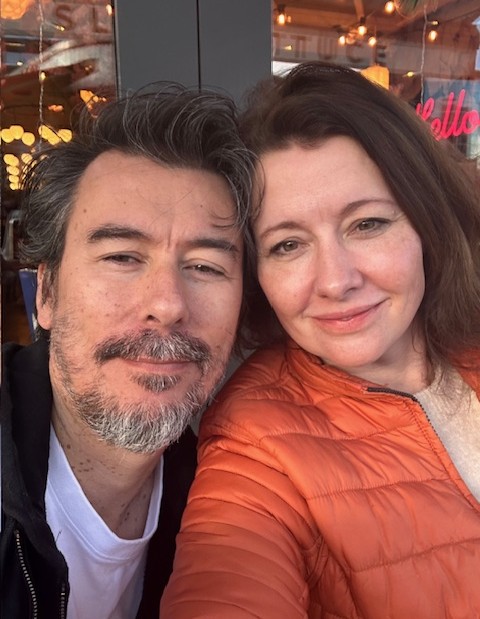
“You hear about how devastating MND is,” she said. “I assumed that, given the awfulness of the disease, I would get lots of support.”
Nicola, from Dunblane, said, “Being forty-six, knowing how devastating the disease is, and living in Scotland, I assumed that I would be very well looked after.”
Before eventually giving up working full-time, Nicola had a career working across government and private sector roles, specialising in process improvement and organisational culture.
Nicola said, “I worked in the environment sector, but I worked my way up through promotion. I was very good at processes, getting teams to deliver, and ensured they were happy and felt supported at work. I know what good support looks like. I know how systems should work when the people within them care enough to try.”
A diagnosis of MND means a person might need support with day-to-day activities, especially as the condition progresses. This can include support getting out of bed, with personal care, with feeding, and with assistive equipment.
When Nicola was diagnosed with MND, she was still able to do things on her own. As the disease progressed, she received support from the council’s temporary ‘re‑enablement team’.
The care she received from council employees was everything she expected, “They were brilliant,” she recalls. “I assumed all care would be like that.”
As her condition progressed, the council moved Nicola onto SDS (Self Directed Support) Option 3 from a private care agency. “I knew there were different SDS options, but one of my carers told me to get the council to organise everything. She was very blunt and I trusted her, so I went with option 3.”
SDS Option 3 means that the local council chooses, arranges, and pays for someone’s care directly – of the four SDS options available, this option tends to mean a person has less control and choice over care, though they should still be involved in decision making. Other options include Option 1, whereby someone receives an agreed amount of money from the council to purchase their own support, and Option 2 which sits between the two: someone chooses how their support budget is used, without managing the money themselves.
She said, ”The private care agency visited. They were late, there was no handover, and within a week, I knew it was not going to work. It was horrendous. Dehumanising.”
Emails went unanswered, her concerns were dismissed, and when Nicola asked to explore other support options, she found obstacles at every turn.
Months passed with no clarity, no guidance, and no progress.
Nicola was told that self-employed personal assistants were not an option, “I spent months trying to make something worth that was impossible. A total waste of time.”
During this time, Nicola reached out to MND Scotland to help get answers.
Meanwhile, she contacted a private care provider on her own, “They told me more in a five-minute call than the council had told me in a year. They made me want to live again,” she said. “But it had taken nearly a year of stress, exhaustion, and relentless self‑advocacy to get there.”
Issues such as delays with getting assessments, a shortage of care staff, a lack of training, and a postcode lottery of care mean that many people are not receiving high-quality, equitable or consistent social care.
This has detrimental impacts on both the person diagnosed with MND and family members who are left to provide exhausting, relentless 24/7 care.
Determined to stay ahead of her condition and avoid a crisis, Nicola planned home adaptations on her own. She hoped for support, but instead, she experienced more delays and miscommunication.
The occupational therapist assigned to Nicola had no experience with MND. Months passed without updates.
When surveyors finally arrived to install a through‑floor lift, they told her the measurements were wrong – another preventable setback.
“I just broke down,” she says. “I was hanging on by a thread.”
Eighteen months after first asking for help, Nicola and her partner felt they had no choice but to self‑fund everything, from paving the front of the house to make a ramp, to converting a utility room into a wet room to accommodate Nicola’s needs.
Nicola hired an independent company that completed the paving for nearly a tenth of the price quoted by the council, “The council put the job out to tender and got two quotes back, one for £21k and another for £31k. We were liable for 20%.”
Nicola and her partner paid approximately £3,000 for the adaptations.
“We achieved in a month what they couldn’t do in 18 months,” she said.
The conversion of the utility room to a wet room was the best option for Nicola. However, she again experienced delays and setbacks.
Nicola said, “The wet room ended up costing us a lot. After yet another delay with the lift, we were in crisis, and a local builder, who had been through something similar with his own dad, stepped in. We didn’t have time to shop around, and we were lucky he was able to accommodate us. He did a brilliant job, quickly, but it was expensive.
“A shower chair rep visited with two Occupational Therapists, and only then did I learn the waste pipe should have been buried so a shower chair could roll over it. I’ve seen five OTs, and none mentioned this, even though they advised on the toilet model. Now we need builders back.”
Nicola continued: “The original application was rejected because of wheelchair turning circles, which caused huge delays and stress. Now that I’ve seen the shower chair, it’s clear my wheelchair won’t even be used in the wet room – I’ll be hoisted from my bedroom. My OT said the earlier assessment was ‘based on my needs at that time,’ but I was still walking then.
“The wetroom is large enough for a wheelchair. One OT’s incorrect assessment, and refusal to listen even to WestMARC (West of Scotland Mobility and Rehabilitation Centre) had a massive impact. That single sticking point caused all the delays and stress, and there’s still no accountability.”
Speaking about her local council, Nicola said, “We rely on these people to be experts.”
Nicola had to use her pension savings to pay for the home adaptions, “I’m lucky I had the money,” she says. “Some people wouldn’t.”
Nicola needed equipment, such as a standing aid, to maintain her mobility. She was repeatedly told items were available ‘in stock’, but months passed without them being delivered.
A mobile hoist sat unused in her bedroom for weeks because no one came to show her how to use it. “All I wanted was to try it,” she said. “It took three months.”
Nicola requested a different occupational therapist, and only then did everything begin to move quickly.
Within hours, her standing aid was ordered, and the next day, it arrived. “It was the perfect piece of equipment for me,” she says. “But why did I have to fight for it? It is not about money being available, this is down to poor performance and apathy.”
As Nicola’s condition progressed, she had to give up doing the things she enjoyed and cared for most. She had to sell her horse, and she had to give up painting. She spent months being housebound before learning about the Independent Living Fund (ILF).
ILF Scotland provides funding support for disabled people in Scotland and Northern Ireland to help them live a more independent lifestyle.
“Everything I’ve found out has not come from the council”, she said.
Nicola describes her life now as part advocacy, part crisis management.
“I feel with my disease, it’s almost a part‑time job,” she says. “I am sick of nudging people, reminding and pushing them. It should not be like this.”
Nicola believes that decision‑makers underestimate the severity of MND. She said, “It may just be a job to them, but it’s my life. They need to step up and stop hiding behind guidance and processes. People need to know their hard‑earned taxpayers’ money is not being used well. Councils are inefficient and ineffective.”
She continued, “I can barely manage this. What about older people or people without advocacy? They are being badly let down.”
Nicola shouldn’t have to spend her time fighting for answers, chasing emails, and project‑managing her own situation. She wants to make time count while weathering the diagnosis and journey of MND.
Ahead of the Scottish Parliament Elections in May 2026, MND Scotland has appealed to the next Scottish Government to legislate and recognise the urgent statutory rights and needs of those with terminal illnesses like motor neuron disease.
The charity is calling on the next government to deliver: invested in, and fast-tracked, housing and adaptations; fast- tracked social care; and increased, targeted funding for neuro-progressive conditions.
MND Scotland would like to thank Nicola for bravely sharing her story.
Nicola hopes her story encourages change, “All I ever wanted was for the council to learn and improve. Something needs to change.
“No one thinks this will happen to them,” she added. “But it could. And people with MND do not have time to waste.”
To read MND Scotland’s 2026 Manifesto, please click here.
To read and sign our open letter, please click here.