What is MND
Find support
I have MND
I am supporting someone
Get involved
Research
About MND Scotland
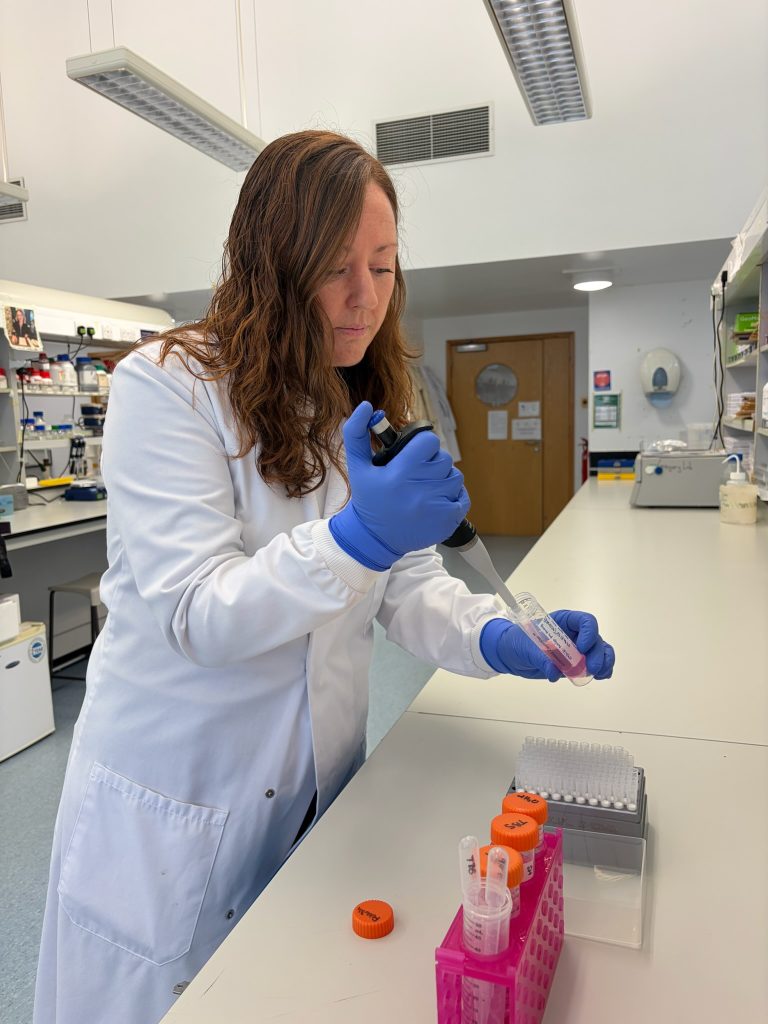
Professor Gregory and her research team discovered that one specific inflammation pathway, known as the type-I interferon pathway, is unusually active in some people with MND, particularly those with certain genetic forms such as C9orf72-related MND. When this pathway is overactive, research shows that people tend to experience faster disease progression, earlier loss of movement, and earlier death.
In laboratory models of MND, Professor Gregory’s lab showed that blocking this pathway slowed disease progression, preserved movement for longer, and extended survival. This provides evidence that overactive interferon signalling is not just a symptom of MND, but a possible driver of the disease, and could be a potential target for investigation.
The team further discovered that not all patients show the same inflammation patterns. Instead, there are distinct “molecular subgroups” of MND that cannot be explained by genetics or clinical features alone. Some of these subgroups are linked to thinking and memory changes seen in the MND–frontotemporal dementia (FTD) spectrum. Two genes in particular, FKBP5 and BDNF, which are linked to memory function and length of survival, may serve as useful biomarkers to track disease or predict outcomes.

The findings of Professor Gregory and her team open the door to future research into new therapies targeting inflammation, especially interferon signalling, to slow disease progression. But also, by understanding more about inflammatory subgroups, doctors may be able to match the right treatment to the right patient, improving the chance of success in clinical trials and beyond, in the future.
The next steps for Professor Gregory and her team in this research are:
Thanks to the data gathered from this MND Scotland funded project, Jenna has been awarded follow-on funding from both UK and international funders, helping to establish Aberdeen as a centre for cutting-edge MND research, and continue this vital research.
Jane Haley, Interim CEO of MND Scotland said: “This research not only sheds light on how inflammation may play a part in why MND progresses differently between people but also opens the door to developing personalised treatments that could slow decline and improve quality of life. Professor Gregory’s work gives hope that, in the future, targeting inflammation could lead to treatments that slow disease progression and make a difference to people living with MND. We are proud to support Professor Gregory’s research and will be interested to see the results as this work progresses.”
 Jenna Gregory said: “We are very grateful to MND Scotland for supporting this research. The funding enabled us to generate findings that have improved our understanding of how inflammation contributes to MND and has helped us secure further national and international investment. This has strengthened Aberdeen’s position as a centre of excellence for MND research and provides a strong foundation for developing more personalised approaches to treatment in the future.”